
From Flax to Linen: How a Plant Becomes Fabric
When we see a linen shirt, dress, scarf or pair of trousers, it is easy to think of linen simply as another fabric. But linen does not begin as fabric. It begins in a field. The journey from a flax plant to a finished piece of linen involves agriculture, natural fibre extraction, mechanical processing, spinning, […]
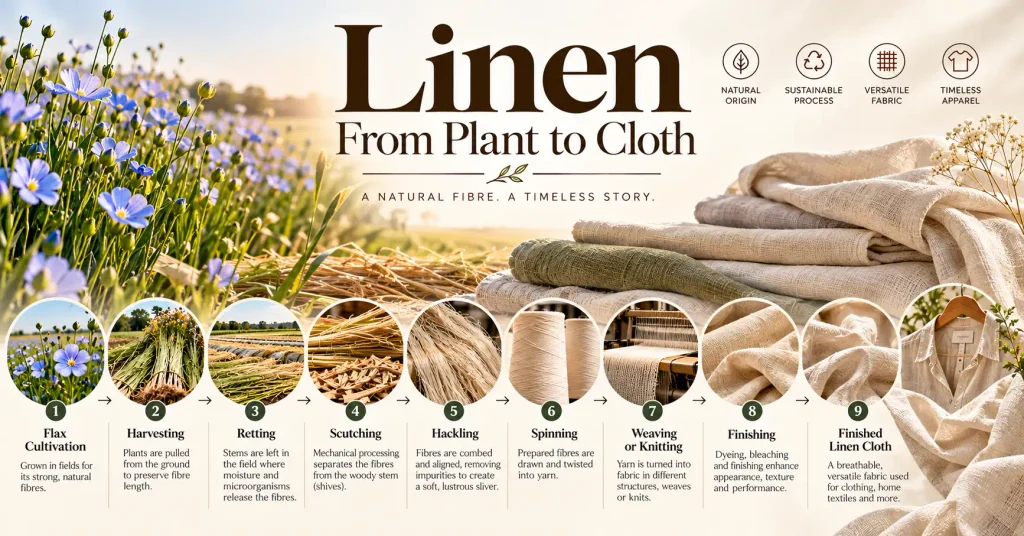
When we see a linen shirt, dress, scarf or pair of trousers, it is easy to think of linen simply as another fabric.
But linen does not begin as fabric.
It begins in a field.
The journey from a flax plant to a finished piece of linen involves agriculture, natural fibre extraction, mechanical processing, spinning, weaving or knitting, and finishing. Each stage changes the material in a specific way, gradually transforming the plant stem into a textile that can be used for clothing, home textiles and other applications.
Understanding that journey also explains something important about linen: the character of the finished fabric is closely connected to what happens long before the fabric reaches a designer or manufacturer.
From the field to the final cloth, every stage matters.
1. What Is Linen?
Linen is a textile made from the fibres of the flax plant, particularly Linum usitatissimum.
The useful textile fibres are found in the outer layers of the flax stem. Unlike cotton, where the textile fibre comes from the plant’s seed hairs, flax is a bast fibre. The fibres run along the length of the stem.
This structure is one reason flax requires a different processing system from many other natural fibres.
The plant has to be harvested in a way that preserves the continuity of the fibres, followed by a process that separates those fibres from the woody parts of the stem.
The transformation is therefore not simply a matter of harvesting and spinning.
There is a sequence of operations between the plant and the yarn.
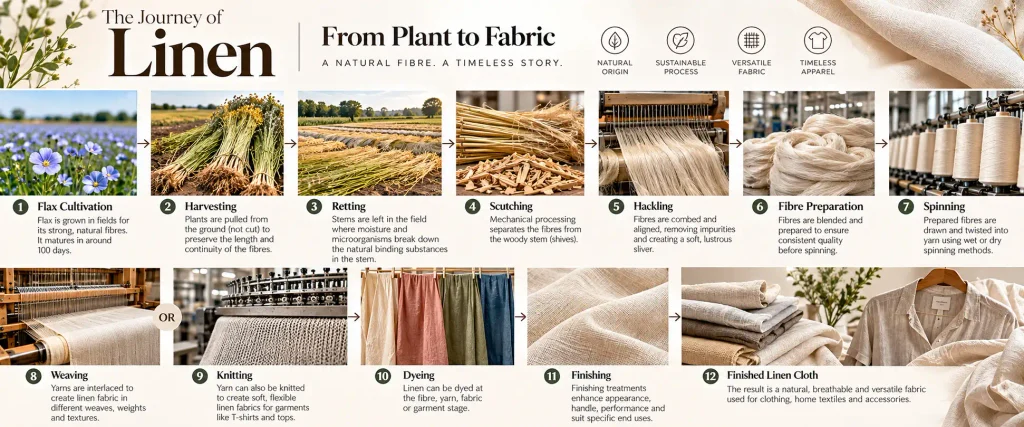
2. It Starts With the Flax Plant
The first stage is cultivation.
Flax is grown specifically for fibre production in many regions, with varieties and agricultural practices influencing the eventual fibre characteristics.
In the European flax-linen process documented by the Alliance, the plant reaches maturity roughly 100 days after seeding and can grow to around 80 centimetres to 1 metre in height.
The quality of the eventual textile begins here.
Growing conditions, variety, soil, weather and harvesting practices all influence the raw material entering the processing chain.
This is an important point when thinking about natural fibres.
A natural textile is not produced from a completely uniform industrial input. It originates from an agricultural crop, which means the material has a relationship with the conditions in which it was grown.
3. Why Flax Is Pulled Rather Than Cut
One of the interesting differences in flax production is the way the plant is harvested.
For fibre flax, the plants are pulled from the ground rather than simply cut.
The reason is connected to fibre continuity.
The textile fibres run through the stem, so preserving the length and integrity of those fibres is important for producing long fibre suitable for higher-quality yarns.
After pulling, the flax stems are laid across the field in rows or swaths.
At this point, the plant still looks very different from the linen fabric that will eventually be made from it.
The next stage begins the actual separation of the textile fibre.
4. Retting: Separating Fibre From the Stem
Retting is one of the most important stages in converting flax into fibre.
The flax stem contains natural substances that bind the textile fibres to the woody core of the plant. Retting helps break down those binding materials so that the fibres can later be mechanically separated.
In field or dew retting, the pulled flax is left on the ground and exposed to moisture, sunlight and microorganisms.
Rain and dew provide moisture, while naturally occurring microorganisms help break down the substances connecting the fibre bundles to the woody material.
This is a carefully managed stage.
If retting is insufficient, fibre extraction becomes more difficult.
If it progresses too far, fibre quality can be affected.
Agricultural research has therefore treated retting as a critical step in determining the quality of the resulting flax fibre.
The process is a good example of how linen production combines natural biological activity with controlled textile processing.
5. Scutching: Extracting the Fibre
After retting, the flax straw is ready for mechanical processing.
This stage is known as scutching.
The objective is to separate the valuable textile fibres from the woody portion of the stem, known as shives.
Scutching involves mechanical crushing and separation. The resulting material can include long fibres, short fibres and other plant components.
The long fibres are particularly important for producing linen yarns.
But the rest of the plant does not necessarily become useless waste.
Depending on the production system, short fibres and shives can be used in other applications such as technical textiles, paper-related applications, animal bedding, panels, mulch and other products.
This makes the processing of flax different from a simple “plant becomes fabric” story.
The plant is separated into different useful streams, each with its own potential application.
6. Hackling: Preparing the Fibre
After scutching, the long flax fibres still need to be organised.
This is where hackling comes in.
Hackling combs and aligns the fibres, removing remaining impurities and arranging the fibres more parallel to one another.
The result is a more uniform ribbon-like material called a sliver.
According to the Alliance’s description of the process, hackling calibrates and stretches the fibres into soft, lustrous ribbons suitable for the next stages of preparation and spinning.
This stage matters because spinning requires a controlled fibre arrangement.
The more consistently the fibres are prepared, the more predictable the yarn-making process can become.
7. Preparing the Fibre for Spinning
The prepared flax fibres are then further organised before spinning.
One interesting aspect of industrial flax production is blending different batches of fibre.
Fibre from different fields, regions and harvest years can be combined to help create more consistent yarn characteristics. The Alliance describes this blending as a way of combining different fibre properties to achieve a more homogeneous and consistent yarn.
This is an important manufacturing principle.
Natural fibres naturally vary.
The objective is not necessarily to eliminate that natural variation, but to manage it so that the final yarn achieves the required characteristics.
8. Spinning: Fibre Becomes Yarn
At this stage, the material is finally beginning to resemble something familiar to the textile industry.
The prepared flax fibres are spun into yarn.
Spinning involves drawing and twisting the fibres so that they form a continuous strand.
Different spinning systems produce different types of yarn.
The Alliance identifies wet spinning and dry or semi-wet spinning among the principal methods used for flax. Wet spinning uses hot water to help smooth the fibres and can produce finer yarns suitable for clothing and household linen, while dry spinning can produce coarser yarns used in furnishings and other applications.
This is where the intended end use begins to influence the material pathway.
A fine garment fabric and a heavier furnishing textile do not necessarily require the same yarn characteristics.
9. From Yarn to Cloth
Once the yarn has been produced, it can be turned into fabric.
One major route is weaving.
Weaving involves crossing two systems of yarn:
- Warp: yarns running along the length of the fabric
- Weft: yarns running across the width
Different combinations and structures produce different fabric appearances and performance characteristics.
Linen can therefore be made into many different types of woven fabrics rather than existing as one single “linen texture.”
The weave structure, yarn characteristics, finishing and fabric weight all contribute to how the final textile looks and behaves.
10. Linen Can Also Be Knitted
Linen does not have to be woven.
It can also be knitted, producing fabrics with different characteristics from traditional woven linen.
Knitting creates loops rather than crossing warp and weft yarns in the same way as woven construction.
The Alliance notes that knitted linen can be used for products such as T-shirts and tops, with different knitting systems used to produce shaped or seamless components.
This is another reminder that “linen” describes the fibre rather than one specific fabric construction.
The same flax-derived fibre can ultimately become different textile structures depending on the intended product.
11. Dyeing, Bleaching and Finishing
The fabric is not necessarily finished when it comes off the loom or knitting machine.
Additional processing can change its appearance and performance.
Linen can be bleached or dyed at different stages of production, including at the fibre, yarn, fabric or garment stage.
Finishing can also modify the characteristics of the textile.
Depending on the intended application, finishing treatments can influence appearance, handle, water resistance and other performance characteristics.
The Alliance describes finishing as a stage that can change the appearance and performance of linen, including treatments designed for particular functional requirements.
This is where a material that began as a plant becomes much closer to the textile product a designer or manufacturer actually works with.
12. Why Every Stage Affects the Final Fabric
The most interesting part of the flax-to-linen journey is that there is no single stage that determines the final fabric.
The result is cumulative.
The agricultural conditions influence the plant.
Harvesting influences fibre length and integrity.
Retting affects fibre separation.
Scutching separates fibre from the woody stem.
Hackling organises the fibres.
Preparation and blending influence consistency.
Spinning determines yarn characteristics.
Weaving or knitting determines fabric construction.
Dyeing and finishing influence appearance and performance.
By the time the textile reaches a fashion manufacturer, it has already passed through a long chain of decisions and processes.
13. What This Means for Fashion Product Development
For a designer, understanding linen begins with more than knowing that it is a natural fibre.
The more useful question is:
What can this particular linen fabric do?
Can it hold a structured silhouette?
Does it drape softly?
How does it react to colour?
How does it behave during cutting and sewing?
Will the finished garment become softer with use?
Is its weight appropriate for the intended climate and season?
These questions connect textile knowledge directly with product development.
The fabric selected for a relaxed summer shirt will not necessarily be the right choice for a structured jacket.
Likewise, the linen suitable for a lightweight scarf may be completely different from the linen required for upholstery.
The fibre is only the beginning.
The yarn, construction, weight and finishing determine much of the material’s final behaviour.
14. From Plant to Product
Looking at linen from the beginning changes the way we understand fabric.
A finished linen garment can look simple.
But behind that simplicity is an extended production chain involving agriculture, natural retting, mechanical fibre extraction, fibre preparation, spinning, fabric formation and finishing.
The finished textile is therefore not just a piece of cloth.
It is the result of a sequence.
And each step leaves something behind in the final material.
The softness, texture, strength, drape and appearance that we experience as consumers or designers are connected to decisions that began long before the fabric reached the cutting table.
15. Final Thoughts
The journey from flax to linen is a reminder that fabric has a history.
It begins with a plant growing in a field.
It is pulled, retted and mechanically processed.
The fibres are separated, combed, prepared and spun.
The resulting yarn is woven or knitted.
The cloth is then dyed, bleached or finished according to its intended use.
Only after all of these stages does it become the linen textile we recognise.
For anyone working in fashion, this journey is worth understanding because good product development starts with understanding the material.
Before the pattern.
Before the cutting.
Before the stitching.
Before the finished garment.
There is the fibre.
And before the fibre, there is the plant.
From field to fibre, from fibre to yarn, and from yarn to cloth — linen is a story of how nature, processing and textile craftsmanship come together to create a material for fashion.
15.1 Frequently Asked Questions
Linen is made from the fibres of the flax plant, scientifically known as Linum usitatissimum.
Flax goes through several stages before becoming fabric: cultivation, harvesting, retting, scutching, hackling, fibre preparation, spinning, and finally weaving or knitting. The fabric may then undergo dyeing, bleaching and finishing.
Flax intended for textile fibre is generally pulled from the ground to help preserve the length and continuity of the fibres running through the stem.
Retting is the process used to loosen the fibres from the woody parts of the flax stem. Moisture and microorganisms help break down the natural substances that bind the fibres together.
Scutching is a mechanical process that separates the useful flax fibres from the woody material of the stem after retting.
Hackling involves combing and aligning the flax fibres, removing remaining impurities and preparing the fibres for spinning.
The prepared fibres are drawn and twisted during spinning to form continuous yarn. Different spinning methods can produce yarns with different characteristics and intended uses.
Yes. Linen can be used to make both woven and knitted textiles. The construction method affects the appearance, structure and behaviour of the finished material.
Many stages can influence the final textile, including the flax variety, growing conditions, harvesting, retting, fibre preparation, spinning, fabric construction and finishing.
Linen is not one single type of fabric. Yarn characteristics, fibre preparation, weave or knit structure, fabric weight and finishing can all change its final texture and appearance.