
The Zinnia India: Building Fashion Products From India for Global Markets
The story of The Zinnia India is closely connected to the story of its founder, Virat Koomar, and his journey through fashion, textiles, product development and manufacturing. Based in Noida, India, The Zinnia India has developed around the creation of fashion products across textiles, garments, resortwear and fashion accessories, with an orientation toward markets beyond […]
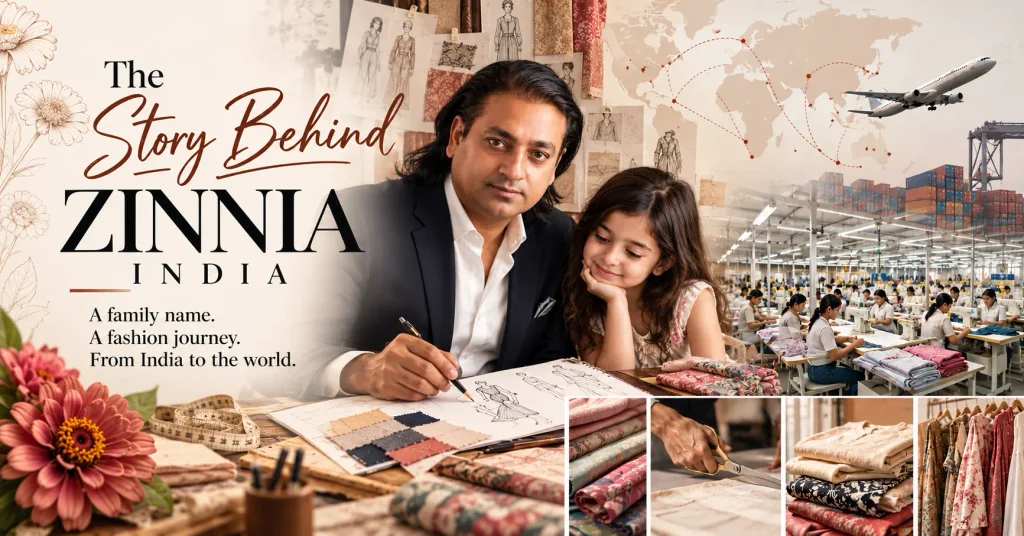
The story of The Zinnia India is closely connected to the story of its founder, Virat Koomar, and his journey through fashion, textiles, product development and manufacturing.
Based in Noida, India, The Zinnia India has developed around the creation of fashion products across textiles, garments, resortwear and fashion accessories, with an orientation toward markets beyond India.
But behind the company is a story that is more personal than the name of a fashion business might initially suggest.
The name Zinnia comes from Virat Koomar’s daughter. What began as a family connection became part of the identity of the business and the wider fashion journey that Koomar built.
Understanding that story provides a different way to look at The Zinnia India—not simply as a manufacturing company, but as a business shaped by a designer’s experience, a family’s name and the development of fashion capabilities in India.
1. The Story Behind the Name Zinnia
The name Zinnia has a personal origin.
Virat Koomar named the business after his daughter, bringing a family connection into the identity of the company.
The decision gave the business a name that was connected to something personal rather than being created purely as a commercial label.
As the company developed, the name Zinnia became associated with Virat Koomar’s work in fashion, textiles, manufacturing and international markets.
The significance of the name therefore goes beyond branding.
It connects the company’s professional journey with the family behind it.
The Zinnia India grew as Virat Koomar developed his experience in fashion and built the capabilities needed to turn fashion concepts into finished products.
2. Virat Koomar and the Fashion Journey
Virat Koomar’s professional background is rooted in fashion and textiles.
His public professional profile describes more than 21 years of experience in the apparel and textile export industry, along with education at the National Institute of Fashion Technology in Delhi.
That background is important when examining the development of The Zinnia India.
Fashion manufacturing can often be viewed simply as a production activity. But a designer’s perspective brings a different understanding of the process.
A designer considers how a fabric behaves.
How a silhouette moves.
How a print interacts with a garment.
How proportions affect the finished product.
How finishing changes the appearance.
And how all these decisions ultimately affect the person wearing the product.
Over time, Koomar’s experience developed beyond the design of individual fashion products and toward building the infrastructure required to develop and manufacture them.
3. From Designer to Building a Fashion Business
The transition from designing fashion to building a fashion business involves a significant change in perspective.
A designer can develop a concept.
A fashion business needs systems capable of turning that concept into a finished product repeatedly.
That means understanding textiles, sampling, production, quality control, finishing and delivery.
It also means understanding what happens when an idea moves from paper or a mood board into an actual piece of clothing or an accessory.
This relationship between creativity and execution became an important part of Virat Koomar’s approach.
The development of The Zinnia India can therefore be viewed as an extension of that experience: moving from understanding fashion products to developing the capabilities required to produce them.
4. Building The Zinnia India
The development of The Zinnia India was not simply about establishing a name in fashion.
It involved building an ecosystem around the fashion product.
Textiles became an important part of the process.
Product development became part of the manufacturing journey.
Sampling allowed concepts to be tested physically.
Manufacturing created the ability to turn approved products into production.
Finishing completed the visual and physical characteristics of the product.
And export connected those products with international markets.
This progression illustrates how a fashion business can develop from creative experience into a broader production and export operation.
5. Five Factories and a Manufacturing Ecosystem
One of the significant parts of The Zinnia India’s development is its manufacturing infrastructure, which includes five factories.
The importance of these facilities is not simply their number.
Manufacturing infrastructure provides the foundation for developing different types of fashion products and managing the practical requirements associated with them.
Different materials behave differently.
Different garments require different construction methods.
Accessories can require specialised finishing.
Resortwear can involve different considerations of fabric, movement and construction.
Having manufacturing capabilities across a broader ecosystem allows these requirements to be considered within the company’s own production environment.
For The Zinnia India, manufacturing is therefore closely connected to the development of the fashion product itself.
6. From Textile to Fashion Product
The journey of a fashion product often starts with the textile.
Fabric selection can influence almost every subsequent decision.
Weight affects how a garment falls.
Texture affects its appearance.
Construction affects durability and movement.
Print affects the visual identity.
Finishing affects how the final product looks and feels.
For a designer-led fashion business, understanding these relationships can be particularly important.
The textile is not simply a raw material.
It can be part of the creative direction of the product.
The development process therefore begins by understanding what the material can do and how it can support the intended design.
7. The Importance of Sampling
Once a concept and material have been selected, the product needs to be developed physically.
This is where sampling becomes important.
A sample allows the design to be examined in three dimensions.
The fabric can be evaluated.
The proportions can be checked.
Construction can be tested.
Finishing can be considered.
And changes can be made before larger-scale production begins.
Sampling is therefore more than producing a first version of a garment.
It is a stage where the relationship between design and manufacturing becomes visible.
The experience of developing fashion products gives manufacturers practical knowledge that can influence these decisions.
8. Manufacturing the Approved Product
Once a product has been developed and approved, production becomes the next stage.
This is where consistency becomes important.
The final production needs to retain the characteristics established during sampling.
Fabric, measurements, construction and finishing all need to remain within the intended specifications.
Quality therefore cannot be separated completely from manufacturing.
It is built into the production process through material handling, cutting, construction, inspection and finishing.
For The Zinnia India, the manufacturing infrastructure provides the physical foundation required to move from product development into finished production.
9. Fashion Accessories and Resortwear
The Zinnia India’s product development extends beyond conventional garments.
Fashion accessories such as scarves and stoles have their own relationship with textiles, design and finishing.
In these products, the fabric itself can become one of the most important elements.
Print, colour, texture, edging and finishing can determine the final appearance.
Resortwear also creates a distinctive relationship between textile and design.
The fabric needs to support movement, comfort and the visual character of the collection.
These categories demonstrate why fashion manufacturing is not simply about sewing garments.
Different fashion products require different combinations of material knowledge, design understanding and production experience.
10. The Connection Between Design and Manufacturing
Virat Koomar’s background as a designer provides an important context for understanding The Zinnia India.
When the person developing the fashion business also understands the creative process, manufacturing can be viewed from the perspective of the finished product.
The question is not simply:
Can this product be manufactured?
It becomes:
How should this product be developed so that the final result remains true to the original idea?
That distinction is important.
A fashion product needs to work technically, but it also needs to retain its design intention.
Fabric, construction, proportions, finishing and production decisions all contribute to that outcome.
11. From Noida to Global Markets
The Zinnia India is based in Noida, Uttar Pradesh, placing the company within India’s wider apparel, textile and manufacturing ecosystem.
Its international orientation has been part of the company’s development.
Public company-profile information associated with The Zinnia India reports activity across 52+ countries, more than 34,563 consignments and 517+ overseas customers. The same profile reports recognition as a Star Export House and two Best Exporter Awards.
These figures should be understood as company/profile claims rather than independently audited statistics.
The company’s presence at international fashion events also demonstrates its connection with global markets.
The 2024 IFJAS exhibitor directory lists The Zinnia India among exhibitors in the fashion and lifestyle sector.
Virat Koomar has also publicly documented participation at international fashion events, including Who’s Next in Paris, where he described products including scarves, stoles and pareos produced through the company’s own manufacturing capabilities.
Together, these activities provide context for the company’s international direction.
12. Why Manufacturing Matters to the Story
The manufacturing side of The Zinnia India is important because it explains how the company moves from ideas to finished products.
Without manufacturing capability, a fashion concept remains dependent on another stage of the supply chain.
With manufacturing infrastructure, the company can bring more of the product-development journey into its own ecosystem.
That does not mean design and manufacturing become the same activity.
Instead, they become connected.
The designer understands the intended product.
The manufacturing process determines how that product can be realised.
The interaction between the two can influence the final result.
This is particularly important when working with textiles and fashion accessories, where material behaviour can significantly influence production.
13. The Zinnia India and Indian Fashion Manufacturing
India’s fashion manufacturing industry has a long connection with textiles and apparel.
But the modern fashion industry requires more than traditional manufacturing skills.
Products need to respond to changing design directions, international quality expectations and increasingly diverse fashion categories.
Businesses operating in this environment therefore need to connect traditional textile knowledge with modern product development and manufacturing systems.
The Zinnia India represents one example of this evolution.
Its story combines Virat Koomar’s experience in fashion with the development of manufacturing infrastructure and an international market orientation.
14. The Founder, the Family and the Business
The story of The Zinnia India also demonstrates how personal identity can become part of a company’s identity.
The name comes from Virat Koomar’s daughter.
The business grew from his experience in fashion and textiles.
The manufacturing infrastructure developed around the requirements of the products.
And the company’s international direction expanded the reach of those products beyond India.
These elements are connected.
The name represents the family.
The founder represents the creative and professional journey.
The factories represent the manufacturing foundation.
And the finished products represent the result of those combined efforts.
15. Building Fashion Products From India
The development of The Zinnia India can therefore be understood as a journey from creative experience to manufacturing capability.
The process begins with an idea.
The idea is connected to a textile.
The textile becomes part of a product.
The product is sampled.
The sample is refined.
Manufacturing turns the approved concept into production.
Finishing completes the product.
And export takes the finished product toward its intended market.
At every stage, decisions made earlier influence what comes later.
That is why fashion product development cannot be reduced to a single manufacturing step.
It is a connected process.
16. Looking Ahead
The story of The Zinnia India continues to sit at the intersection of fashion, textiles, manufacturing and international markets.
Its development under Virat Koomar shows how experience in fashion can evolve into a wider business built around the ability to develop and manufacture products.
The five-factory manufacturing infrastructure provides a production foundation.
The company’s textile and fashion experience provides product knowledge.
Its international orientation connects Indian production with global markets.
And the name itself carries a personal connection to the family behind the business.
For The Zinnia India, the journey is ultimately about turning ideas into fashion products.
From textile selection to product development.
From sampling to manufacturing.
From Indian production to global markets.
And behind the name is a founder who built the business around his experience in fashion, while giving it a name that began with his daughter.
The Zinnia India is, at its core, a story of fashion being built from India—and carried into the world.