
Why Fabric GSM Matters in Garment Manufacturing
When selecting fabric for a garment, colour, texture, print and fibre composition are often the first things people notice. But there is another specification that can significantly influence how a fabric performs: GSM. GSM stands for grams per square metre. It describes the weight of a fabric based on a standard area of one square […]
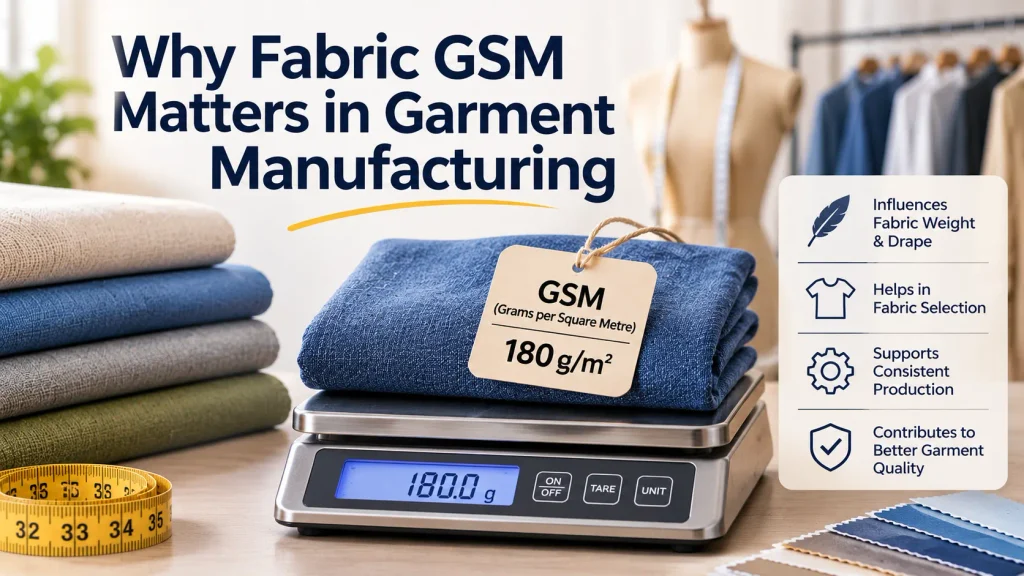
When selecting fabric for a garment, colour, texture, print and fibre composition are often the first things people notice.
But there is another specification that can significantly influence how a fabric performs: GSM.
GSM stands for grams per square metre. It describes the weight of a fabric based on a standard area of one square metre.
Although GSM is a simple measurement, it can provide useful information about the physical character of a textile. It can help designers, product developers, manufacturers and buyers compare fabrics and understand whether a material is suitable for a particular product.
GSM does not tell you everything about a fabric.
Two fabrics with the same GSM can behave very differently because fibre type, yarn construction, weave or knit structure, finishing and other characteristics also matter.
However, GSM is an important part of understanding the material before it becomes a garment.
1. What Does GSM Mean?
GSM is the weight of fabric in grams per square metre.
For example, if one square metre of a fabric weighs 150 grams, its nominal GSM is 150.
The measurement provides a common reference for comparing fabrics.
A lower-GSM fabric is generally lighter by weight than a higher-GSM fabric, although weight alone does not determine how a fabric feels or behaves.
This distinction is important.
A lightweight fabric can have considerable structure, while a relatively heavier fabric can still have a soft or fluid drape depending on its construction.
GSM should therefore be considered as one part of the overall fabric specification rather than a complete description of the textile.
2. Why GSM Matters During Fabric Selection
Fabric selection is not simply about choosing a material that looks appropriate.
The fabric needs to work with the intended product.
A summer shirt, structured jacket, flowing dress, scarf and heavy outer layer may all require very different textile characteristics.
GSM can help establish whether a fabric falls within the expected weight range for the product.
For a lightweight garment, a very heavy fabric may affect comfort, movement and appearance.
For a structured product, an extremely lightweight fabric may not provide the desired body.
This makes GSM useful during the early stages of product development.
It gives the team a measurable specification to consider alongside fibre content, construction, finish, colour and other fabric characteristics.
3. GSM and Fabric Drape
Drape describes how fabric falls, folds and moves.
GSM can influence drape, but it does not determine it by itself.
A fabric’s drape is also affected by fibre properties, yarn characteristics, weave or knit structure, finishing and fabric construction.
This is why two fabrics with similar GSM can produce completely different results in the same garment.
One may fall softly around the body.
Another may hold its shape.
A third may feel crisp or structured.
The relationship between GSM and drape therefore needs to be evaluated physically rather than assumed from the number alone.
4. GSM and Garment Weight
The weight of the fabric contributes to the overall weight of a finished garment.
This can become particularly relevant when developing products that use larger quantities of fabric.
A garment made from a heavier textile will generally contain more fabric weight than an otherwise comparable garment made from a lighter textile.
The difference can influence handling, packaging, transport and the way the garment feels when worn.
For this reason, fabric weight can be relevant not only to design but also to production planning.
5. GSM in Knitted and Woven Fabrics
GSM is used across different types of textiles, including woven and knitted fabrics.
However, the same GSM does not mean that two fabrics will have identical characteristics.
A knitted fabric has a loop-based structure and may have stretch and recovery properties that are very different from a woven fabric.
A woven fabric may have a stable construction but can vary considerably depending on its weave, yarn density and finishing.
Consequently, GSM should always be considered alongside the construction of the fabric.
The number provides useful information, but the textile structure explains how that weight is distributed and how the material may behave.
6. GSM and Fabric Thickness Are Not the Same
One common misunderstanding is to treat GSM and thickness as interchangeable measurements.
They are not.
GSM measures mass per unit area.
Thickness measures the physical depth of the material.
A fabric with a particular GSM may have a different thickness from another fabric with the same GSM because of differences in fibre, yarn, construction and finishing.
This distinction matters when selecting fabrics for a specific application.
A product developer may need a particular combination of weight, thickness, softness, structure and drape rather than simply targeting one GSM value.
7. Why Consistent GSM Matters in Production
Once a fabric has been approved for production, consistency becomes important.
If the production fabric differs significantly from the approved material in weight or construction, the finished product may not behave in exactly the same way.
Changes in fabric weight can potentially influence:
- Garment appearance
- Drape
- Handle
- Comfort
- Fabric consumption
- Construction
- Finishing
- Overall product consistency
This is why fabric specifications should be clearly communicated and controlled during production.
The objective is not simply to receive fabric that looks similar.
The objective is to receive material that meets the agreed specifications.
8. GSM and Fabric Consumption
GSM can also be relevant when evaluating fabric consumption.
Fabric consumption is generally concerned with the amount of fabric required to produce a garment, while GSM describes the weight of the fabric per square metre.
These are different measurements, but they can be considered together when evaluating the material requirements of a product.
A higher-GSM fabric may contribute more weight to each garment when the same approximate fabric area is used.
At larger production quantities, this can become relevant to planning and logistics.
However, fabric consumption itself depends on many other factors, including fabric width, pattern dimensions, garment construction, marker efficiency and the product’s design.
9. GSM and Fabric Width Should Be Considered Together
GSM tells you the weight of a square metre.
Fabric width tells you how much usable width is available across the roll.
These specifications can have different implications for production.
A fabric with a particular GSM but a different usable width may require different marker planning from another fabric with the same GSM.
This is one reason fabric specifications should be reviewed as a group rather than in isolation.
GSM, width, construction, composition, finish and performance characteristics all contribute to understanding whether a textile is suitable for production.
10. How GSM Is Measured
GSM can be determined by weighing a known area of fabric.
A fabric sample with a defined area is weighed, and the result is converted to grams per square metre.
In professional textile testing, controlled methods and appropriate instruments can be used to obtain more reliable measurements.
The purpose is to establish a consistent reference for the material.
This becomes particularly useful when comparing fabric lots, approving materials or checking whether production fabric remains within an agreed specification.
11. Why GSM Should Not Be Used Alone
GSM is useful, but it should never become the only criterion for fabric selection.
Imagine two fabrics with the same GSM.
One could be cotton.
Another could be viscose.
A third could be polyester.
They may have completely different levels of drape, softness, strength, stretch, moisture behaviour and appearance.
Even two fabrics made from the same fibre can behave differently because of yarn and construction differences.
This is why fabric development requires a broader understanding of the textile.
GSM is one measurement within that larger picture.
12. GSM During Product Development
During product development, fabric decisions often evolve through several stages.
A designer may begin with a visual concept.
The product developer considers possible materials.
Fabric samples are reviewed.
The material is tested and evaluated.
A sample garment is produced.
The team then assesses how the fabric performs in the actual product.
GSM can be part of the technical information recorded during this process.
It provides a measurable characteristic that can be referenced when comparing fabrics and communicating specifications.
The physical sample remains important because numbers alone cannot completely describe the behaviour of a textile.
13. From Fabric Specification to Finished Product
A garment is the result of several connected decisions.
Fabric is selected.
Its specifications are established.
Patterns are developed.
Samples are constructed.
Corrections are made.
Production begins.
The final product must then remain consistent with the approved standard.
GSM sits near the beginning of this chain.
It is a relatively simple measurement, but it contributes to a broader understanding of the material being used.
When fabric specifications are clear, communication between design, product development, sourcing, production and quality teams becomes easier.
14. Final Thoughts
Fabric GSM is a simple concept with practical importance in garment manufacturing.
It provides a standard way of describing fabric weight and can help teams compare materials, develop products and establish technical specifications.
But GSM should never be treated as a complete description of a fabric.
A fabric’s weight is only one part of its identity.
Fibre, yarn, construction, width, thickness, finish, drape, strength and other performance characteristics all contribute to how the material behaves.
The most useful approach is therefore to treat GSM as one piece of a larger fabric knowledge system.
Before a textile becomes a garment, it needs to be understood as a material.
And sometimes, one of the simplest numbers on a fabric specification sheet can provide an important starting point.
15. FAQ’s
GSM stands for grams per square metre. It indicates the weight of a fabric based on an area of one square metre.
Fabric GSM helps manufacturers and product developers understand and compare fabric weight when selecting materials for garments and establishing technical specifications.
Not necessarily. GSM measures fabric weight, while thickness measures the physical depth of the material. Fibre type, yarn, construction and finishing can cause fabrics with similar GSM to have different thicknesses.
GSM can influence how a fabric behaves, but it does not determine drape by itself. Fibre properties, yarn, weave or knit structure and finishing also affect how fabric falls and moves.
Yes. GSM can be used to describe the weight of both woven and knitted fabrics, although their construction and performance characteristics can be very different.
Yes. Two fabrics with the same GSM can have different fibre compositions, yarn structures, constructions and finishes, resulting in different drape, softness, stretch and performance.
GSM can be determined by weighing a known area of fabric and expressing its weight in grams per square metre. Professional textile testing can use controlled methods and suitable equipment for more consistent results.
Yes. Fabric weight contributes to the overall weight of a finished garment. The final garment weight also depends on the amount of fabric and other components used.