
Why Sample Corrections Save Problems in Production
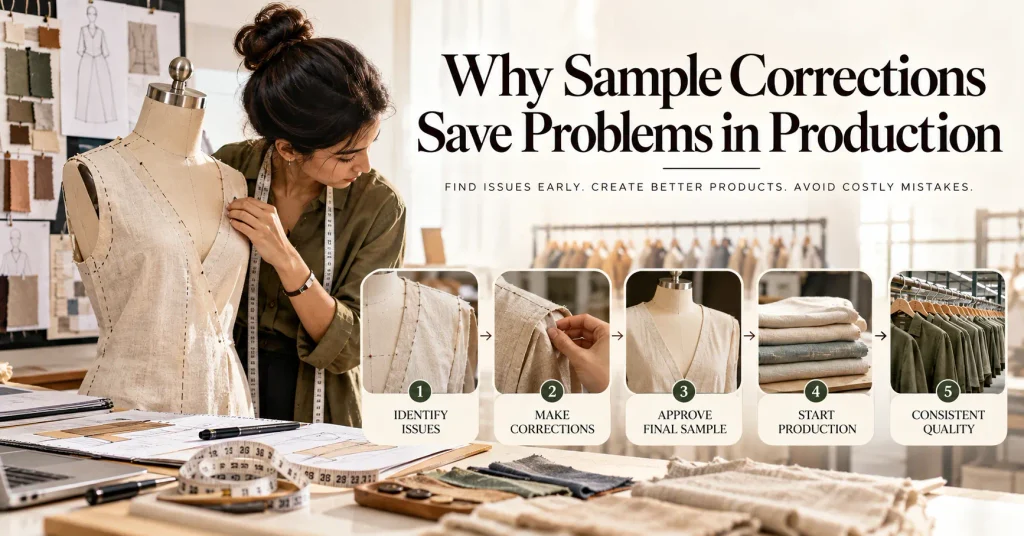
In fashion manufacturing, production does not really begin when hundreds or thousands of pieces enter the factory. It begins much earlier. Before bulk cutting, stitching, finishing and packing, there is usually a sample that needs to be examined, tested and corrected. A sample may look finished, but its real purpose is to answer a much […]
In fashion manufacturing, production does not really begin when hundreds or thousands of pieces enter the factory.
It begins much earlier.
Before bulk cutting, stitching, finishing and packing, there is usually a sample that needs to be examined, tested and corrected.
A sample may look finished, but its real purpose is to answer a much more important question:
Will this product actually work when it goes into production?
This is why sample corrections are such an important part of fashion product development. A small issue discovered during sampling can often be corrected with relatively little disruption. The same issue discovered after bulk production has started can affect fabric consumption, measurements, construction, finishing, delivery schedules and overall production cost.
The sample stage is therefore not simply about approving how a garment looks.
It is a stage for finding problems before those problems become production problems.
1. Why Sampling Comes Before Production
A fashion design can begin as a sketch, reference image, technical drawing or product specification.
But a drawing cannot completely predict how a physical product will behave.
Once the design is made using an actual fabric, construction method and set of components, new information becomes visible.
The neckline may sit differently than expected.
The sleeve may require adjustment.
The fabric may fall differently from the original expectation.
A seam may create unwanted bulk.
A print may not sit correctly after construction.
A measurement that appeared correct on paper may not produce the intended fit.
The sample brings these issues into the physical world.
That is why the first sample should be viewed as a development tool rather than simply a finished product waiting for approval.
2. A Sample Reveals What a Sketch Cannot
A drawing represents an idea.
A sample represents that idea in material form.
The difference is significant.
Fabric has weight, stretch, drape, thickness and movement. Construction introduces seams, joins, layers and finishing details. Once all of these elements come together, the product may behave differently from what was originally imagined.
This is where sample review becomes important.
The sample can be examined from different perspectives:
- Does the overall silhouette look correct?
- Are the proportions balanced?
- Does the garment sit correctly on the body?
- Is the fabric appropriate?
- Are the seams positioned correctly?
- Are the details in the right place?
- Does the product remain practical to manufacture?
The answers may lead to corrections.
That is not a failure of the development process.
It is exactly what the development process is supposed to achieve.
3. Fit and Measurement Corrections
One of the most obvious areas for correction is fit.
A garment may technically match the measurements provided, but still not produce the intended appearance when worn.
The shoulder could be too wide.
The sleeve could be too tight.
The body could require additional ease.
The neckline might need to be adjusted.
The length could affect the balance of the entire garment.
These details become much easier to evaluate once an actual sample exists.
Corrections can then be made before production specifications are finalised.
This matters because a measurement change in one area can affect other parts of the garment.
For example, changing the length of a garment may influence pocket placement, print positioning, seam placement or the relationship between different panels.
A sample allows these relationships to be checked together.
4. Fabric Behaviour During Sampling
Fabric selection and garment construction are closely connected.
A pattern that works well with one fabric may not behave in the same way with another.
A lightweight fabric may create more movement.
A heavier fabric may produce more structure.
A fabric with greater drape may change the appearance of a silhouette.
A textured material may affect seams or surface details.
A stretch fabric may require different construction considerations from a stable woven fabric.
This is why sampling with the actual or approved production fabric is important whenever possible.
The sample provides an opportunity to see whether the material and design are working together.
Sometimes the correction is made to the pattern.
Sometimes the fabric needs to be reconsidered.
Sometimes the construction method needs to change.
The earlier this is discovered, the easier it is to make a controlled decision.
5. Construction Problems
Some problems cannot be identified simply by looking at a design drawing.
They appear during construction.
A seam may become too bulky.
A panel may not align properly.
A particular construction sequence may make production unnecessarily difficult.
A curved seam may require adjustment.
A facing or lining may not sit correctly.
A sleeve attachment may need to be changed.
These are exactly the kinds of issues that sampling can expose.
The objective is not to eliminate every possible complication before the first sample.
The objective is to identify them while there is still time to solve them.
6. Print, Embroidery and Placement Issues
Surface details create another area where sample corrections can be critical.
A print may appear correctly positioned on artwork but look different once the garment is assembled.
Embroidery may need adjustment because of seam placement.
A motif can become visually unbalanced if it is positioned too close to an edge.
A repeat pattern may require more careful alignment.
Buttons, labels, trims and other components can also affect the final appearance.
A physical sample provides a much better opportunity to evaluate these details than a specification sheet alone.
This becomes particularly important when a product contains several design elements that need to work together.
7. Why Small Corrections Matter
Some sample corrections may appear insignificant.
Changing a measurement by a small amount.
Moving a pocket slightly.
Adjusting a seam.
Changing the position of a print.
Reducing unnecessary bulk.
Correcting a sleeve opening.
But small changes can have larger consequences once production begins.
A small measurement problem repeated across hundreds of garments becomes a production issue rather than an individual sample issue.
Likewise, a small placement mistake repeated throughout a collection can affect the appearance and consistency of the entire order.
The sample stage gives manufacturers an opportunity to solve these issues once, before they are repeated many times.
8. What Happens When Corrections Are Skipped?
When a sample is approved without sufficient review, unresolved problems can move into bulk production.
At that point, correcting the issue may require much more time and material.
Depending on the problem, production may need to be paused.
Patterns may need to be changed.
Cut components may need to be reviewed.
Some pieces may require alteration or rework.
In more serious cases, an issue discovered late can affect the entire production run.
This is why rushing through sample approval can create a false sense of efficiency.
Saving time during sampling does not necessarily mean saving time overall.
Sometimes a few additional hours spent correcting a sample can prevent much larger delays later.
9. From Corrected Sample to Production
Once the sample has been reviewed and corrections have been made, the next step is to establish the production-ready version.
This can involve updating measurements, patterns, construction instructions, artwork, placement specifications and other technical details.
The corrected sample becomes an important reference.
It helps the production team understand what the approved product should look and feel like.
This is especially important when multiple people are involved in the manufacturing process.
The more clearly the approved product is documented, the less room there is for interpretation during production.
10. The Communication Between Design and Manufacturing
Good sampling is not only a technical exercise.
It also requires communication.
Designers may be focused on proportion, appearance and concept.
Manufacturing teams may be focused on construction, efficiency, material consumption and production feasibility.
The sample provides a common physical reference for both sides.
Instead of discussing an abstract idea, the team can examine an actual product.
That makes conversations more specific.
Instead of saying that something “doesn’t look right,” the discussion can focus on exactly what needs to change.
Should the sleeve be wider?
Should the hem be shorter?
Should the fabric be lighter?
Should the seam move?
Should the embroidery be repositioned?
This level of specificity makes corrections more useful.
11. Sampling Is Part of Product Development
It is tempting to think of sampling as a step that happens between design and production.
In reality, sampling is part of product development itself.
The first sample provides information.
The corrected sample provides more information.
Each round can bring the product closer to the intended result while also revealing what is practical to manufacture.
The goal is not necessarily to create endless rounds of samples.
The goal is to use each sample intelligently.
A well-reviewed sample can help establish a clearer production standard and reduce uncertainty before bulk manufacturing begins.
12. Final Thoughts
A fashion sample is more than a small version of a production order.
It is a test.
It tests the relationship between design, fabric, fit, construction, detailing and manufacturing.
That is why sample corrections matter.
A problem found at the sample stage is still a problem that can be solved relatively early.
The same problem found after bulk production has started can become expensive, time-consuming and difficult to reverse.
In fashion manufacturing, perfection does not necessarily mean getting everything right on the first attempt.
It means having a process that identifies what is wrong, corrects it and carries those corrections forward into production.
A sample gives you the opportunity to make a mistake once. Production gives you the opportunity to repeat it hundreds of times.
That is why careful sample correction is not a delay in production.
It is one of the ways production becomes more predictable.
Sample corrections are changes made to a garment or fashion product after reviewing a physical sample. They can involve fit, measurements, fabric behaviour, construction, print placement, embroidery, trims and other details before bulk production begins.
Sample corrections help identify and resolve problems before they are repeated across a larger production quantity. Correcting an issue during sampling can reduce rework, material waste, production delays and quality problems later.
A sample review can include measurements, fit, proportions, fabric behaviour, seam construction, finishing, print or embroidery placement, trims and the overall appearance of the product.
Yes. Different fabrics can have different levels of weight, drape, stretch, thickness and structure. These characteristics can affect how a garment fits and behaves, which may require changes to the pattern or construction.
If an unresolved problem reaches bulk production, it may be repeated across many units. Depending on the issue, this can lead to alterations, rework, material loss, production delays or inconsistencies in the finished products.
There is no fixed number. The number of sample rounds depends on the complexity of the product, the number of corrections required, fabric and construction considerations, and whether the sample meets the required specifications.
A first sample is used to evaluate and develop the product. A production-ready sample reflects the approved corrections and specifications that should be followed during bulk manufacturing.
Virat Koomar
Founder
LATEST BLOGS

Greater Noida’s International Fashion Fair: IFJAS 2025 and Zinnia India’s Award
The fashion industry is shaped not only by designers and brands but also by the manufacturers, exporters, artisans and businesses...
Zinnia Company: What to Know About The Zinnia India
The Zinnia India is a fashion manufacturing and export company based in Noida, Uttar Pradesh. Established in 2004, the company...
What a Fashion Trade Fair Teaches You That the Internet Never Will
The fashion industry has changed dramatically with the growth of digital platforms. Today, designers can explore international collections, manufacturers can...