
How Textile Testing Helps Prevent Problems in Garment Production
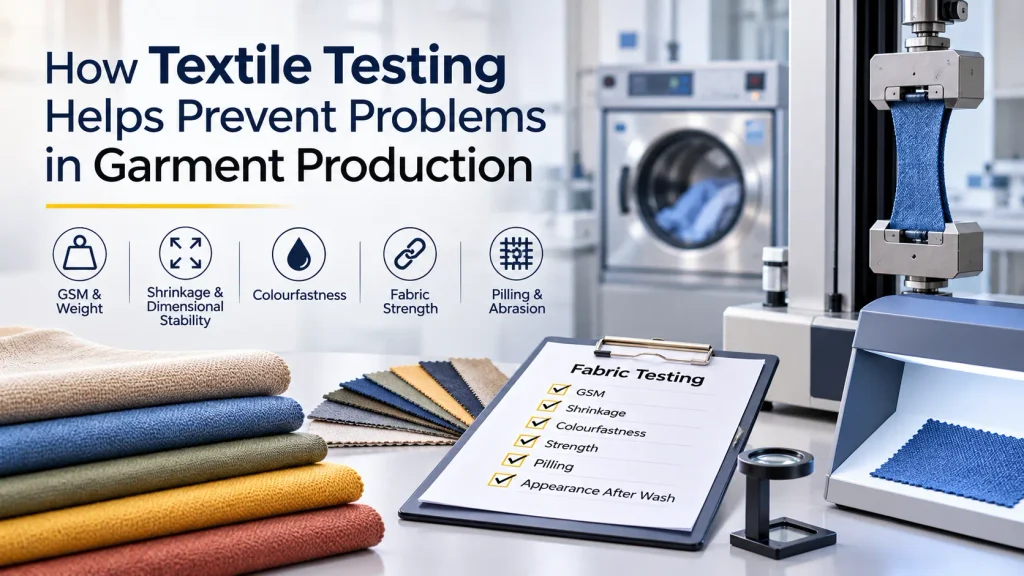
A garment may look perfect on a cutting table or during the first fitting, but that does not always mean the fabric is ready for production. A fabric can shrink after washing, lose colour through rubbing, develop pilling, change in appearance, or fail under stress. Some problems only become visible after the garment has already […]
A garment may look perfect on a cutting table or during the first fitting, but that does not always mean the fabric is ready for production.
A fabric can shrink after washing, lose colour through rubbing, develop pilling, change in appearance, or fail under stress. Some problems only become visible after the garment has already been cut and stitched.
This is why textile testing is an important part of garment development and manufacturing.
Testing provides measurable information about how a fabric is likely to behave. It helps manufacturers compare the material against specifications, identify potential problems before production and make better decisions about whether a fabric is suitable for a particular garment.
The objective is not simply to prove that a fabric is “good.”
The objective is to understand whether the fabric is right for the intended product and its expected use.
1. What Is Textile Testing?
Textile testing is the systematic evaluation of fibres, yarns, fabrics or garments to measure specific physical, chemical or performance characteristics.
Depending on the material and end use, testing can examine properties such as:
- Fabric weight or GSM
- Dimensional stability and shrinkage
- Colourfastness
- Tensile and tear strength
- Bursting strength
- Pilling
- Abrasion resistance
- Seam strength
- Fibre composition
- Fabric construction
- Stretch and recovery
- Appearance after washing
The exact testing programme varies according to the product, material and buyer requirements. Textile laboratories and testing organisations commonly use established ISO, ASTM and AATCC methods for these measurements.
2. Why Testing Should Happen Before Production
One of the biggest advantages of textile testing is timing.
A problem discovered before cutting can usually be addressed much more easily than a problem discovered after hundreds or thousands of garments have been produced.
Imagine a fabric that shrinks significantly after washing.
If that behaviour is identified during development, the pattern, fabric allowance or processing method can be reviewed.
If it is discovered only after production, the same issue can affect an entire shipment.
The same principle applies to colourfastness, fabric strength, pilling and other properties.
Testing moves quality control closer to the point where decisions can still be changed.
3. 1. Fabric GSM and Weight
GSM, or grams per square metre, is one of the basic measurements used to describe fabric weight.
A change in GSM can affect how a fabric feels, drapes and behaves during garment construction.
For example, a lightweight fabric and a heavier fabric may have the same general fibre composition but behave very differently when used for a garment.
Testing fabric weight helps determine whether production material is consistent with the approved specification.
This is particularly important when a garment has been developed around a particular fabric weight.
GSM testing is commonly included in textile testing programmes.
4. 2. Shrinkage and Dimensional Stability
Shrinkage is one of the problems that can create a direct connection between fabric testing and garment fit.
A fabric may change in length or width after washing or other treatments.
If this change is not understood before cutting, the final garment may not retain its intended measurements.
This is why dimensional stability testing is important.
The fabric can be tested under defined washing and drying conditions, with the dimensional change measured afterward.
The result gives the production team information that can be considered when preparing patterns and production specifications.
Shrinkage testing is a standard part of textile and garment testing programmes.
5. 3. Colourfastness
Colour is one of the most visible aspects of a garment, but colour performance matters just as much as colour selection.
Colourfastness testing examines how well colour withstands particular conditions.
Depending on the intended use, testing may examine resistance to:
- Washing
- Rubbing
- Perspiration
- Light
- Water
- Other specified conditions
For example, rubbing can cause colour to transfer from one textile surface to another, while washing can produce colour change or staining.
These are not merely laboratory concerns. They can become visible problems for the person wearing the garment.
Established textile testing programmes therefore commonly include colourfastness to washing, rubbing, perspiration and light.
6. 4. Fabric Strength
A fabric needs to withstand the stresses associated with cutting, sewing, wearing and care.
Strength testing helps determine how much force a material can withstand before it fails.
Depending on the fabric construction, different strength measurements may be relevant.
Woven fabrics may be evaluated for tensile and tear strength, while knitted fabrics may also require bursting-strength testing.
The right test depends on the construction and intended use of the material.
A fabric that performs well visually but has insufficient strength for its application can create problems later in production or during wear.
7. 5. Pilling and Abrasion
Some fabrics develop small balls or fibres on their surface after repeated rubbing. This is known as pilling.
Abrasion testing examines how a textile responds to repeated rubbing or wear.
These properties are especially important for garments that experience frequent contact with other surfaces.
A fabric may look excellent when it is new but develop an undesirable surface appearance after use.
Testing can provide an indication of how the textile may perform before the garment reaches the customer.
Pilling and abrasion resistance are among the commonly assessed textile properties in laboratory testing.
8. 6. Seam Strength and Garment Construction
Fabric performance is only one part of garment durability.
Once fabric becomes a garment, the seams and construction also need to perform.
Seam strength and seam slippage tests can help assess whether the fabric and sewing construction are likely to withstand expected stresses.
This illustrates an important distinction:
A strong fabric does not automatically mean a strong garment.
The relationship between fabric, thread, stitch type, seam construction and garment design also matters.
Garment testing programmes can therefore include seam strength, seam slippage and other construction-related assessments.
9. 7. Appearance After Washing
A garment can meet its measurements before washing and still change afterward.
Washing may influence:
- Dimensions
- Surface appearance
- Shape
- Colour
- Texture
- Overall garment appearance
For this reason, some testing programmes evaluate the appearance of fabric or garments after laundering.
This is particularly relevant when the final product is intended for regular washing.
The question is not simply, “Does the garment look good when it leaves the factory?”
It is also:
“How does it look after the customer uses it?”
Appearance-after-washing testing is therefore an important bridge between manufacturing quality and real-world product performance.
10. 8. Testing Helps Connect Fabric to the End Product
One of the most useful ways to think about textile testing is to connect each test with a potential production or customer problem.
| Test | What it helps evaluate |
|---|---|
| GSM | Fabric weight and specification |
| Shrinkage | Dimensional change |
| Colourfastness | Colour performance |
| Tensile strength | Resistance to breaking |
| Tear strength | Resistance to tearing |
| Pilling | Surface durability |
| Abrasion | Resistance to repeated rubbing |
| Seam strength | Garment construction durability |
| Fibre analysis | Fibre composition |
| Appearance after washing | Post-care appearance |
The exact tests and acceptance limits should always be determined according to the product, end use, buyer specification and applicable requirements.
11. Testing Is Part of Product Development
Textile testing should not be viewed only as a final quality-control activity.
It can also support product development.
When a designer or product developer understands the behaviour of a fabric, decisions about silhouette, construction, finishing and intended use become more informed.
For example, a fabric with particular shrinkage behaviour may require consideration during pattern development.
A fabric with limited strength may not be appropriate for a high-stress garment construction.
A textile with specific colourfastness characteristics may need to be evaluated against its intended care conditions.
Testing therefore creates a feedback loop between material selection and product design.
12. What Happens When Testing Is Skipped?
When testing is insufficient, problems may appear at different stages.
During cutting, dimensional instability may create concerns about fabric measurements.
During sewing, unsuitable fabric behaviour can make construction more difficult.
During finishing, colour or appearance problems may become visible.
After washing, garments may change in size or appearance.
During use, pilling, seam failure, colour transfer or fabric damage may become apparent.
The cost of the problem also tends to increase as production progresses.
A material issue discovered during development is easier to address than a material issue discovered after finished garments have been packed.
13. From Fabric Test to Finished Garment
A well-developed garment is the result of many connected decisions.
The process can be viewed as:
Fibre → Yarn → Fabric → Testing → Sampling → Corrections → Production → Finished Garment
Testing sits between material selection and production for an important reason.
It provides evidence.
Instead of relying only on appearance or touch, the development team can use measurable information to understand how the material behaves.
That information can then be considered alongside design requirements, construction methods and end-use expectations.
14. Final Thoughts
Textile testing is not simply about finding faults.
It is about understanding the material before committing it to production.
Shrinkage testing can help protect garment dimensions. Colourfastness testing can reveal how colour behaves under different conditions. Strength testing can provide information about durability. Pilling and abrasion testing can help evaluate surface performance.
Together, these tests create a clearer picture of the textile.
For fashion product development, that knowledge matters because the fabric is not just a surface on which a design is placed.
It is part of the product itself.
The better the material is understood before production begins, the fewer surprises there are when that material becomes a finished garment.
14.1 Frequently Asked Questions
Textile testing is the process of measuring the physical, chemical and performance properties of fibres, yarns, fabrics or garments to determine whether they meet specified requirements.
Textile testing helps identify potential problems with fabric performance before large-scale production begins. It can help manufacturers evaluate properties such as shrinkage, colourfastness, strength, pilling and dimensional stability.
Common tests include GSM or fabric weight, shrinkage, colourfastness, tensile strength, tear strength, abrasion resistance, pilling, fibre composition and dimensional stability.
Colourfastness testing evaluates how well the colour of a textile resists change or transfer when exposed to conditions such as washing, rubbing, perspiration, water or light.
GSM, or grams per square metre, helps establish the weight of a fabric. Testing GSM can help verify that production material is consistent with the approved fabric specification.
Testing can help improve production decisions by providing measurable information about how a textile is likely to perform. It can identify potential material problems before they affect a larger quantity of garments.
Yes. Many fabric properties can be tested before cutting and sewing. Testing at this stage can provide useful information for fabric approval, product development and production planning.
Without appropriate testing, issues such as unexpected shrinkage, colour transfer, insufficient strength or poor surface durability may only become apparent during production or after the garment has been used or washed.
Virat Koomar
Founder
LATEST BLOGS
How Textile Dyeing Changes the Character of Fabric
Colour is often one of the first things we notice about a fabric. But in textile manufacturing, dyeing is not...
Why Fabric Shrinkage Matters Before Cutting
In garment manufacturing, fabric is often treated as the starting point of production. But fabric does not always remain exactly...
Why Sample Corrections Save Problems in Production
In fashion manufacturing, production does not really begin when hundreds or thousands of pieces enter the factory. It begins much...