
Understanding the Journey From Textile to Finished Fashion Product
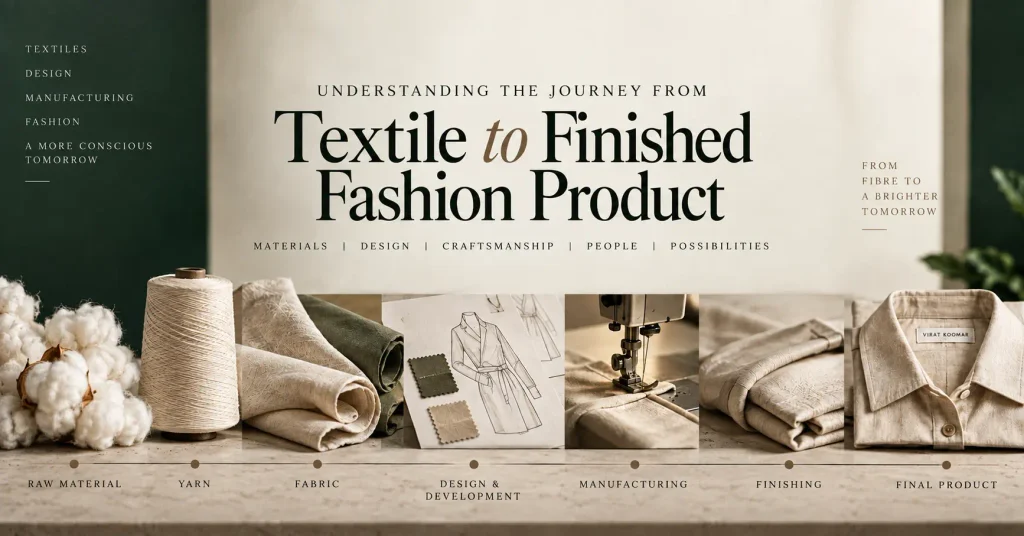
A finished fashion product may look simple when it reaches a store, showroom or customer. But behind every garment, scarf, resortwear piece or fashion accessory is a sequence of decisions that begins much earlier—with the selection and development of the right textile. The journey from textile to finished fashion product is where design, material knowledge, […]
A finished fashion product may look simple when it reaches a store, showroom or customer. But behind every garment, scarf, resortwear piece or fashion accessory is a sequence of decisions that begins much earlier—with the selection and development of the right textile.
The journey from textile to finished fashion product is where design, material knowledge, product development and manufacturing come together. A strong concept alone is not enough. The fabric, construction, finishing, fit, production method and intended market all have to work together to create a product that is both visually compelling and commercially viable.
1. It Begins With the Textile
Every fashion product starts with a material decision.
The designer or product development team needs to consider more than colour and appearance. Fibre composition, weight, weave, texture, drape, durability, shrinkage, surface finish and end use all influence how a fabric will perform.
A lightweight textile may work beautifully for a flowing resortwear garment but may not have the structure required for tailored clothing. Similarly, a fabric that looks impressive in a swatch may behave very differently once it is cut, stitched and finished.
This is why textile selection should happen as part of the design process rather than being treated as a decision made after the design is complete.
2. Turning an Idea Into a Product
Once the appropriate textile has been identified, the creative concept begins to take physical form.
At this stage, designers consider silhouettes, proportions, construction details, prints, trims, embellishments and finishing techniques. A sketch provides the visual direction, but the actual product requires technical decisions that translate that idea into something manufacturable.
This is where communication between design and production becomes particularly important.
A design may need to be adjusted according to the characteristics of the selected textile. Seams, panels, closures and finishing details may need to change depending on how the material behaves. The objective is not simply to reproduce a sketch but to preserve the design intention while making the product technically achievable.
3. Sampling Is Where the Design Meets Reality
Sampling is one of the most important stages in fashion product development.
The first sample provides an opportunity to evaluate the relationship between the textile and the design. It can reveal issues that are difficult to identify from a drawing or fabric swatch.
The garment may require adjustments to its fit, proportions or construction. The fabric may need a different finishing treatment. A particular detail may need to be simplified or engineered differently for production.
This process can involve several rounds of development. Each sample provides information that helps move the product closer to its intended result.
For brands producing for international markets, this stage is especially important because consistency and repeatability become essential once a product moves into larger-scale production.
4. From Sample to Production
Once the product has been approved, the development process moves towards production.
Patterns, measurements, specifications, construction details and approved materials need to be clearly defined. The manufacturing team then has to translate the approved sample into multiple units while maintaining consistency.
This is where production planning becomes important.
Fabric consumption, cutting efficiency, stitching operations, finishing requirements, quality checkpoints and packaging all influence the final product. A design that looks excellent as a single sample must also work efficiently and consistently at production scale.
Good manufacturing is therefore not simply about producing more units. It is about maintaining the relationship between design intent, material quality and production consistency.
5. Quality Is Built Into the Process
Quality control should not be treated as something that happens only after manufacturing is finished.
It begins with the material itself.
Fabric inspection, colour consistency, measurements, construction, stitching, finishing and final appearance all contribute to the quality of the finished product. Different products also require different quality priorities.
A resortwear garment may depend heavily on fabric hand-feel, drape and finishing, while a structured garment may require greater attention to construction and fit.
Understanding these differences helps manufacturers and brands create appropriate quality standards for each product.
6. The Importance of Finishing
Finishing is often what gives a product its final character.
Washing, pressing, embroidery, printing, dyeing, trimming, edge finishing and other processes can significantly influence how a textile looks and feels.
A carefully selected fabric can lose its intended character if the finishing process is not appropriate. Conversely, the right finishing technique can enhance the material and make the final product feel more refined.
This is one reason why textile knowledge and manufacturing experience are closely connected.
7. Designing for the Market
A fashion product also has to exist within a market.
The textile, silhouette, colour, construction and finishing should ultimately make sense for the customer and the market where the product will be sold. Price positioning, seasonality, functionality, cultural preferences and consumer expectations can all influence product development.
For products intended for global markets, this becomes even more important. A successful product needs to combine the identity of its design with practical considerations related to its intended market.
8. From Indian Textiles to Global Fashion
India has a diverse textile and manufacturing ecosystem, ranging from traditional textile techniques to modern garment production and export-oriented manufacturing.
This creates opportunities for fashion businesses to develop products that combine material heritage with contemporary design.
But the value does not come from the textile alone. It comes from understanding how that textile can be transformed into a product that meets modern design, quality and commercial requirements.
The journey from textile to finished fashion product is therefore not a straight line. It is a process of collaboration between material, design, craftsmanship, technology and manufacturing.
9. The Product Is More Than the Fabric
A textile is the starting point, not the finished story.
Between the fabric and the final fashion product are dozens of decisions that determine how the material will ultimately be experienced by the customer. Every stage—from selection and sampling to construction, finishing and quality control—adds another layer to the product.
The strongest fashion products are created when these stages are considered together rather than separately.
A textile provides the material. Design gives it direction. Manufacturing gives it structure. And thoughtful product development turns it into fashion.
9.1 FAQ Section
A textile becomes a finished fashion product through several stages, including material selection, design development, sampling, pattern development, manufacturing, finishing and quality control.
The characteristics of a textile—including fibre composition, weight, drape, texture, durability and finishing—directly affect the design, construction and performance of the final product.
Sampling is the process of creating an initial physical version of a fashion product to evaluate its design, fit, construction, materials and finishing before production.
Once a sample is approved, production specifications, patterns, measurements and materials are finalised before the product moves into manufacturing.
Quality control helps maintain consistency in materials, measurements, construction, stitching, finishing and the overall appearance of products during manufacturing.
Finishing processes such as washing, pressing, printing, embroidery and edge finishing can significantly affect the appearance, texture, durability and final character of a fashion product.
Understanding how different textiles behave allows designers to develop products that work with the material’s drape, structure, weight, construction requirements and intended use.
Virat Koomar
Founder
LATEST BLOGS

Zinnia India: Fashion Manufacturing, Design & Global Export
The fashion industry is changing the way brands think about manufacturing. For many businesses, manufacturing is no longer simply about...
Fashion Accessories Exporter India: Where Manufacturing Meets Design and Resortwear
India has long been recognised for its textile heritage, skilled craftsmanship and manufacturing capabilities. Today, these strengths are becoming increasingly...

Virat Koomar: Building Fashion Businesses Across Design, Textiles and Global Markets
cturing and consumer fashion has influenced my approach to brand building. A fashion business needs both sides. Product needs substance....